
Magnesia-chrome bricks are alkaline refractory materials with periclase (MgO) and magnesia-chrome spinel (MgCr₂O₄) as their main mineral components. Due to their excellent high-temperature performance, they play an irreplaceable role in key equipment in industries such as steel smelting, cement, and glass.
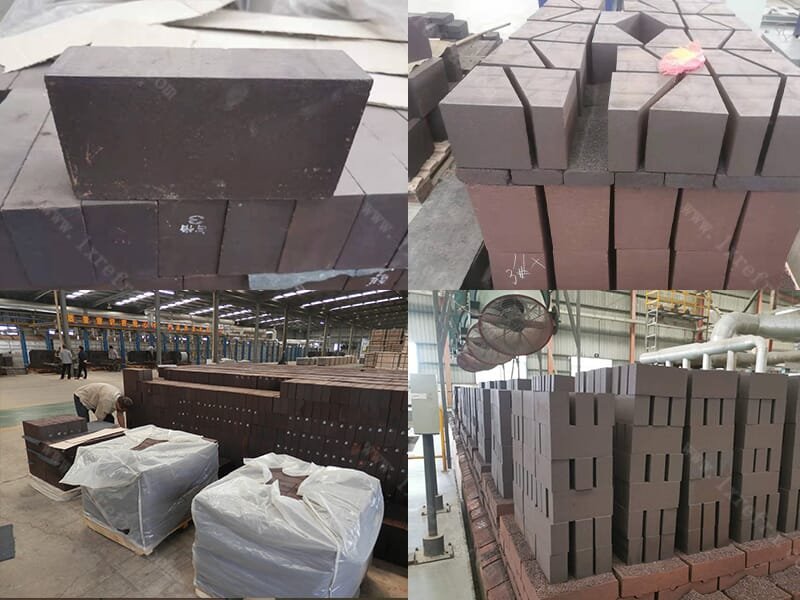
Their core performance advantages are reflected in the following aspects:
Excellent high-temperature resistance and erosion resistance
Magnesia-chrome bricks generally have a refractoriness above 2000℃ and a high load softening temperature (up to above 1600℃), maintaining structural stability and resisting deformation under high temperature and heavy loads. Simultaneously, they exhibit extremely strong resistance to alkaline slags and slags containing FeO and CaO, which is the fundamental reason why they are used in areas where slag erosion is most severe (such as slag lines). Their erosion resistance is closely related to the production process; low-impurity, high-purity raw materials and high-temperature firing processes enable “direct bonding” between the main crystalline phases, thereby significantly improving their slag resistance and high-temperature strength.
Excellent Thermal Shock Resistance
Compared to ordinary magnesia bricks, magnesia-chrome bricks exhibit better resistance to rapid temperature changes without cracking. This allows them to withstand frequent and severe temperature fluctuations in applications such as electric furnaces and refining furnaces.
Diverse Performance and Environmental Challenges
Depending on raw materials and processes, magnesia-chrome bricks can be further categorized into silicate-bonded, directly bonded, and rebonded types, each with specific performance characteristics tailored to different parts of industrial furnaces. For example, pre-reacted magnesia-chrome bricks, due to their uniform composition and low porosity, exhibit particularly excellent slag resistance. However, the greatest limitation of magnesia-chrome bricks lies in their environmental risk—the potential generation of toxic hexavalent chromium ions during use and disposal has become a key factor restricting their application and driving the development of alternative materials.