
Magnesia chrome bricks are key alkaline refractory materials in the metallurgical industry. Their classification system is mainly based on chemical composition, production process, and microstructure, with each type having different performance characteristics and application scenarios.
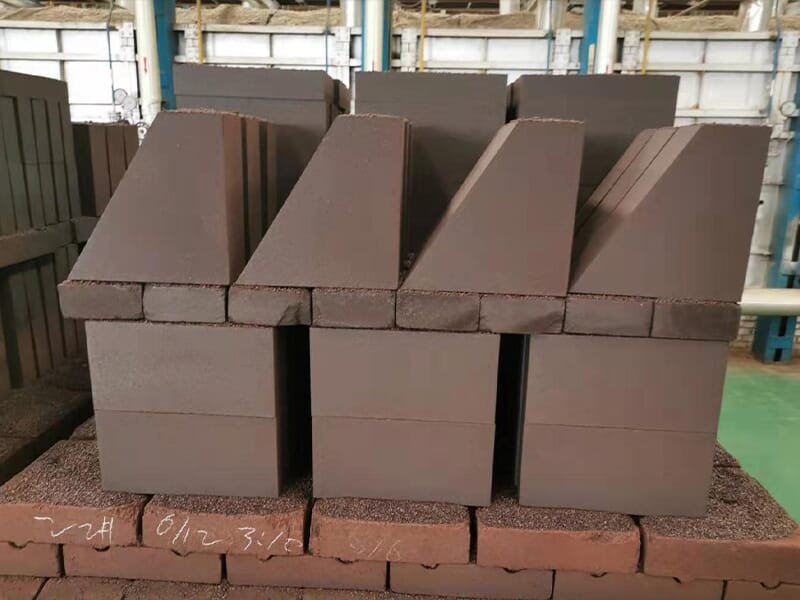
Classification by Chemical Composition
Magnesia chrome bricks can be further subdivided into magnesia chrome bricks (Cr₂O₃ 5-20%), chrome-magnesia bricks (Cr₂O₃ 20-35%), and chrome bricks (Cr₂O₃ >35%). Domestic standards typically use grades such as MGe-8 to MGe-20, where the numbers represent the percentage content of Cr₂O₃.
Classification by Production Process and Microstructure
Ordinary magnesia chrome bricks (silicate bonded): These have lower raw material purity and are fired at approximately 1550℃. Their crystals are bonded by low-melting-point silicates, resulting in poor erosion resistance and high-temperature strength.
Directly Bonded Magnesia chrome Bricks: These are made from high-purity raw materials and fired at ultra-high temperatures above 1700℃. Pernicar magnesia and spinel grains are in direct contact, significantly improving slag resistance and high-temperature strength, making it the most widely used high-quality product.
Rebonded/semi-rebonded magnesia chrome bricks: Made from fused magnesia-chrome sand. They have a uniform microstructure, high strength, and excellent erosion resistance, but relatively poor thermal shock resistance.
Unfired magnesia chrome bricks: Made with chemical binders at low temperatures, requiring no high-temperature firing, but not suitable for long-term storage.
In addition, there are special types such as fused cast magnesia chrome bricks, suitable for areas with extremely severe wear. Due to the environmental hazards of hexavalent chromium, the industry is actively developing chromium-free alternatives.