
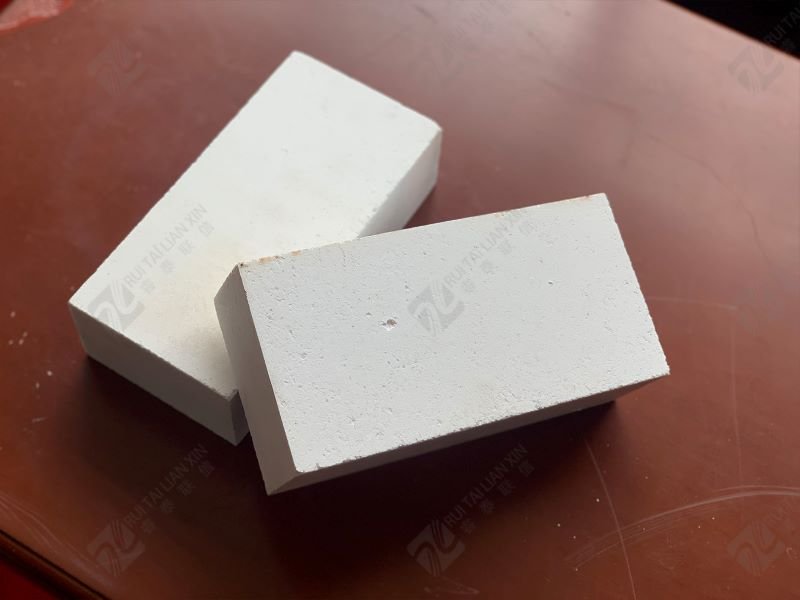
Corundum bricks are high-purity refractory products with alumina (Al₂O₃) as the main crystalline phase, typically containing over 90% Al₂O₃. Their core advantages are high temperature resistance, high strength, and strong corrosion resistance, making them suitable for extreme working conditions above 1600℃.
1. Extremely high refractoriness
Corundum brick possess extremely high refractoriness; pure corundum bricks can reach temperatures above 1990℃. Long-term service temperature is 1600–1800℃, and short-term resistance to ultra-high temperatures of 2000℃ is possible. The softening temperature under load is above 1700℃, far superior to ordinary refractory materials such as clay bricks and high-alumina bricks.
2. Excellent mechanical properties
They exhibit excellent mechanical properties, with a compressive strength of up to 340MPa at room temperature, high hardness, and good wear resistance. They maintain structural stability at high temperatures, exhibit strong creep resistance, and can withstand heavy loads and material erosion, making them suitable for high-wear, high-load environments.
3. Excellent chemical stability
It exhibits excellent chemical stability, showing good resistance to acidic slag, alkaline slag, molten metal, and molten glass. High-purity corundum bricks are particularly resistant to alkali corrosion, resulting in a long service life in harsh environments such as metallurgy, glassmaking, and chemical industries.
4. Good density
Corundum bricks possesses good density, with high bulk density and low porosity, providing strong impermeability and effectively preventing the penetration of molten steel, aluminum, and other melts.
5. Poor thermal shock resistance
The disadvantages include poor thermal shock resistance; it is prone to cracking under rapid temperature changes, and the raw material and sintering costs are high, resulting in an expensive price.
Corundum bricks are mainly used in the linings and key components of high-temperature furnaces such as metallurgical blast furnaces, steel ladles, glass melting furnaces, and petrochemical cracking furnaces.