
The performance indicators of fire bricks directly determine their core properties such as high-temperature resistance and erosion resistance, and are key criteria for adapting to different industrial scenarios. They mainly include the following categories:
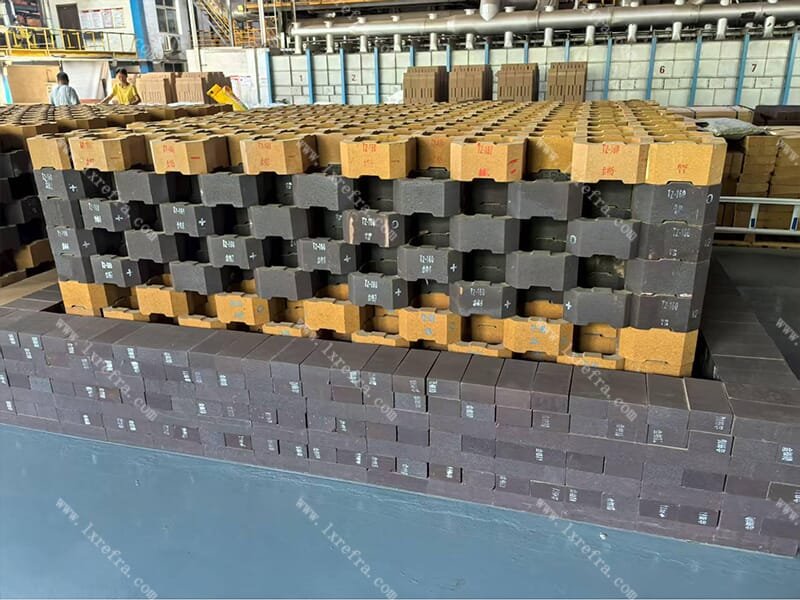
1. Refractoriness
This refers to the fire brick’s ability to resist melting at high temperatures, and is the most basic indicator. It is usually expressed in cone numbers (e.g., SK32, SK34), corresponding to temperatures of approximately 1710℃ and 1750℃, respectively. The appropriate indicator must be selected based on the kiln’s operating temperature to avoid softening and deformation at high temperatures.
2. Room Temperature Compressive Strength
This reflects the brick’s ability to resist pressure at room temperature, affecting the stability of the masonry and its impact resistance. The unit is MPa. Ordinary clay fire bricks generally have a strength ≥20MPa, while high-alumina fire bricks have a strength ≥30MPa. Insufficient strength makes them prone to breakage during transportation or use.
3. High-Temperature Volumetric Stability
High-temperature volumetric stability, also known as thermal stability, refers to the brick’s ability to change volume during repeated heating and cooling processes. It is measured by the reheat linear change rate (usually tested at 1350℃ for 2 hours). The rate of change should ideally be controlled within ±0.5%; otherwise, cracks and spalling are likely to occur due to thermal expansion and contraction.
4. Slag Resistance
The ability to resist erosion and penetration by molten slag and liquid metal depends on the compatibility between the brick’s chemical composition and the slag. Acidic fire bricks (siliceous) have strong resistance to acidic slag, basic fire bricks (magnesia) have excellent resistance to basic slag, and neutral refractory bricks (high-alumina, chromium) are suitable for complex slag environments.
5. Apparent Porosity
This refers to the volume percentage of open pores in the brick, affecting erosion resistance and thermal conductivity. The lower the porosity, the better the density and the stronger the resistance to slag penetration. Generally, high-quality fire bricks have an apparent porosity ≤22%.
6. Thermal Conductivity
This determines the brick’s insulation performance. In the low-temperature zone (200℃), the thermal conductivity is typically 0.8-1.2 W/(m・K). The appropriate thermal conductivity should be selected based on the kiln’s insulation requirements to reduce energy consumption.
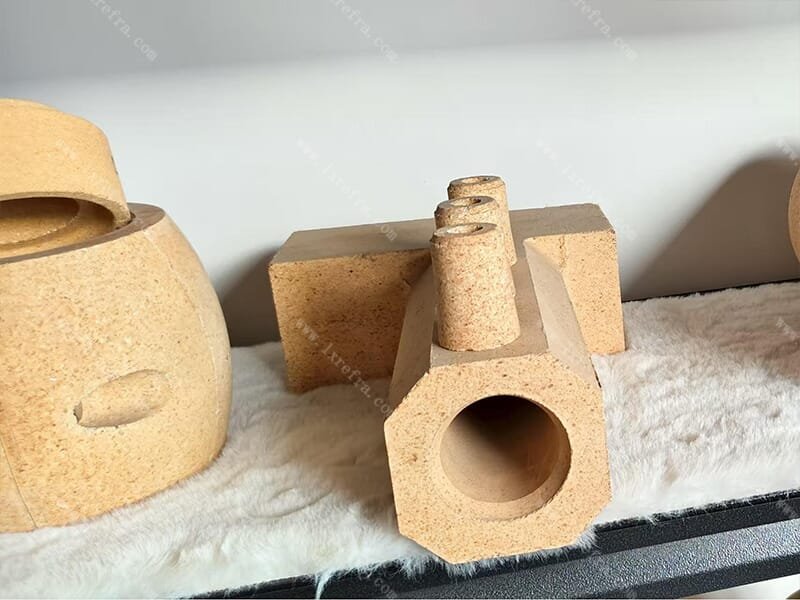
In addition, there are auxiliary indicators such as flexural strength and density, which need to be comprehensively matched with the kiln conditions of different industries such as steel, cement, and glass to ensure the long-term stable use of fire bricks.
Henan Ruitai Lianxin Refractory Materials Co., Ltd is a modern R&D-centered refractory manufacturer manufacturing enterprise integrated with refractories sales and marketing, furnace engineering construction, recycling and sales of waste refractories as well as refractory raw material, technology and goods import and export, and technical services. If you have any needs for refractory materials, please contact us and we will provide you with the best service.