
Copper smelting converters are the core equipment for producing crude copper through matte blowing. The selection of furnace bricks directly determines the equipment’s operating efficiency, production safety, and the service life of the refractory materials. The core requirements must adhere to four principles: high-temperature resistance, resistance to molten copper and slag erosion, thermal shock resistance, and resistance to mechanical erosion. Precise adaptation to different furnace zone conditions is crucial, balancing practicality and economy.

The operating conditions of different furnace zones in copper smelting converters vary significantly, necessitating targeted material selection.
Furnace body and waist
The furnace body and waist are the basic temperature-resistant and load-bearing areas, with temperatures ranging from 1250 to 1350℃. Because directly bonded magnesia-chrome bricks can offer high cost-effectiveness. Therefore magnesia-chrome bricks are preferred. When environmental requirements are higher, magnesia-alumina spinel bricks can be used instead.
Furnace opening and flue opening
The furnace opening and flue opening experience severe thermal shock and erosion, making them critically vulnerable areas. Because magnesia-chrome bricks have high-density and high-strength rebonded. So magnesia-chrome bricks are required, along with matching magnesia-chrome ramming mixes for easy on-site repair.
Furnace bottom and slope
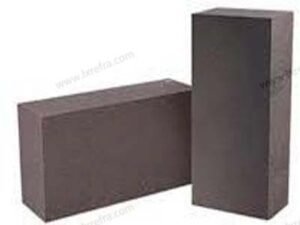
The furnace bottom and slope, in direct contact with molten copper and matte, are subjected to the hydrostatic pressure of heavy metals. Because magnesia-chrome bricks or fused magnesia-chrome bricks have high-density. So bonded magnesia-chrome bricks or fused magnesia-chrome bricks are selected, with a magnesia ramming mix as a buffer layer.
Copper taphole and slag taphole
The copper taphole and slag taphole are subjected to high-speed erosion, so fused magnesia-chrome bricks, with their superior corrosion resistance, are preferred.
Currently, environmental protection demands are prominent in overseas markets, so making chromium-free magnesia-alumina spinel bricks a key focus of promotion. New top-blown converters require high-end fused rebonded magnesia-chrome bricks. Scientific material selection can extend the lifespan of furnace bricks, reduce production costs, and contribute to the efficient and stable operation of the copper smelting industry.