
The production of lightweight high-alumina fire bricks begins with carefully selected raw materials, primarily high-alumina clinker and clay, with a small amount of sawdust added to adjust the consistency of the raw material. To maintain the stability of the slurry, electrolytes such as Al2(SO4)3 are added during the manufacturing process. The addition of a foaming agent with low surface tension is crucial for forming a stable and uniformly distributed foam slurry, a key step in ensuring the ideal porous structure of the lightweight high-alumina fire bricks.
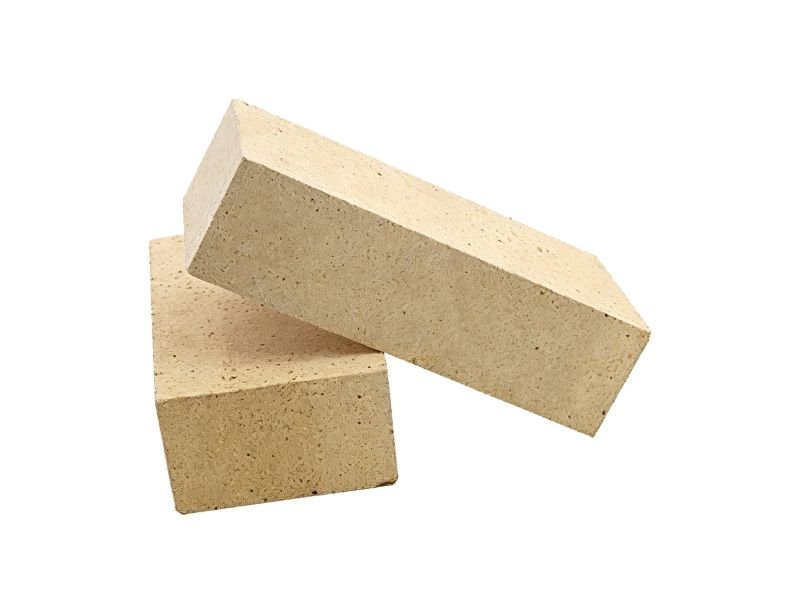
In the molding stage, the foam slurry is poured into molds using a casting method. Precise control of temperature and time during the drying process ensures the uniformity and stability of the green body. Especially after initial low-temperature drying, a high-temperature drying process is performed to further remove residual moisture, preparing for the subsequent firing stage.
The firing stage is the core of lightweight high-alumina fire brick manufacturing, requiring a high temperature of 1300–1350℃ and a holding time of 4–6 hours. This ensures sufficient physicochemical reactions occur within the material, achieving the desired refractoriness and mechanical strength.
The properties of lightweight high-alumina fire bricks are equally impressive. With a bulk density controlled between 0.4 and 1.0 g/cm³, its lightweight characteristic gives it a significant advantage in reducing structural load. Meanwhile, its high porosity of 66% to 67% not only reduces the material’s thermal conductivity but also enhances its insulation performance. These properties make lightweight high-alumina fire bricks widely applicable in the insulation layers and linings of high-temperature industrial kilns, as well as in other applications requiring refractory insulation.