
Fire bricks are core consumables in kiln production lines, directly determining the kiln’s service life and production stability. Then considering the demands of high-temperature, corrosive, and mechanically impact-sensitive conditions, clay bricks, high-alumina bricks, silica bricks, and magnesia bricks are the four most widely used types, suitable for different kiln sections.
Clay Bricks
Clay bricks offer excellent cost-effectiveness. Made primarily of clay, with an Al₂O₃ content of 30%-48%, they withstand temperatures of 1580-1770℃ and exhibit excellent thermal shock resistance. So commonly used in low-temperature sections, flues, and insulation layers of kilns. They are a fundamental choice for small and medium-sized kilns, balancing cost and practicality.
High-Alumina Bricks
High-alumina bricks are the mainstay in medium- and high-temperature kiln sections. With an Al₂O₃ content ≥48%, their temperature resistance and strength increase with increasing content, reaching temperatures of 1770-1850℃. So they offer superior corrosion resistance compared to clay bricks and are widely used in critical areas. Such as the firing zone of cement rotary kilns and the regenerator chambers of glass kilns, adaptable to complex operating conditions.
Silica Bricks
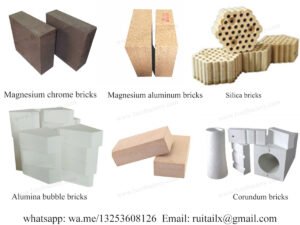
Silica bricks are made from quartz sand, with a SiO₂ content ≥93%. They withstand temperatures up to 1690-1730℃ and exhibit good high-temperature volume stability, so making them suitable for lining areas with long-term high temperatures and no drastic temperature fluctuations. Such as coke ovens and glass kiln melting sections. However, their thermal shock resistance is poor, and sudden cooling and heating should be avoided.
Magnesia Bricks
Magnesia bricks are alkaline fire bricks with a high MgO content. They have strong resistance to alkaline slag erosion and withstand temperatures above 1800℃. They are mainly used in steelmaking converters and non-ferrous metal smelting kilns under highly corrosive conditions. And they are a core fire material for metallurgical kilns. Therefore proper selection can significantly extend kiln maintenance cycles and ensure continuous and efficient production.